

A realistic look at session timelines, disclosure steps, and how mediation saves months compared to court.
The short answer
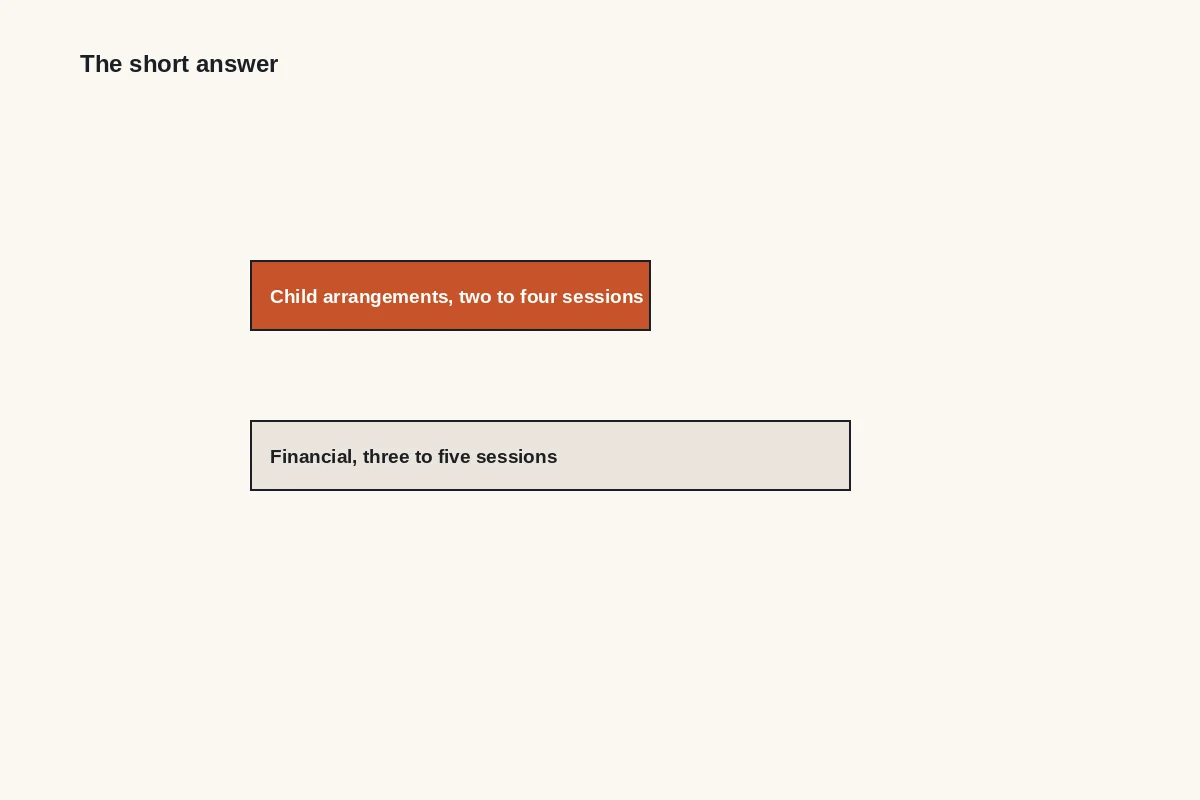
Child arrangements usually take two to four sessions of about ninety minutes each, spread across six to ten weeks. Financial matters take three to five sessions across two to four months. The sessions themselves are not what takes the time. Waiting for documents is.
Why there is a gap between sessions
Sessions are deliberately spaced a week or two apart, and people sometimes ask to compress them. We advise against it for two reasons.
The first is practical. A parenting arrangement that sounds workable in a room is tested by an actual week. Families who try a pattern between sessions come back with real information: the Tuesday handover clashes with football, or the child is exhausted on Monday mornings. That information changes the plan for the better and it cannot be obtained in a meeting.
The second is that decisions made when everyone is tired get revisited. A four hour session produces an agreement that feels settled and unravels a fortnight later. Two ninety minute sessions produce less on the day and more that survives.
What actually causes delay

Pension valuations
A cash equivalent transfer value commonly takes several weeks to arrive, and public sector schemes are frequently at the slower end. Where a defined benefit scheme is involved and an actuarial report is needed, add several weeks more.
This is the single largest cause of a financial case running long, and it is almost entirely avoidable. Request the valuation at the point of your first enquiry rather than when the mediator asks for it. Couples who do this routinely finish a month sooner than couples who do not.
Mortgage capacity
Whether one of you can buy the other out is a lender's answer. Until a broker has confirmed borrowing capacity, discussions about the house are hypothetical. Speaking to a broker early converts weeks of speculation into a session of decisions.
Waiting for a first appointment
Availability varies. A MIAM can usually be arranged within a week or two. Joint sessions depend on both parties' diaries, and coordinating two working adults is often the constraint rather than mediator availability.
A realistic timeline for a financial case
Week one: enquiry, MIAM booked, pension valuation requested. Week two or three: MIAMs completed for both parties. Week four: first joint session, disclosure exchanged and gaps identified. Weeks five to eight: valuations arrive, second and third sessions work through options. Weeks nine to twelve: agreement reached, memorandum and open financial statement drafted. Then solicitors prepare the consent order and the court approves it, which typically adds a further six to twelve weeks depending on court workload.
A realistic timeline for child arrangements
Week one: enquiry and MIAM. Weeks two to three: second MIAM and first joint session. Weeks four to six: the arrangement is trialled and adjusted at a second session. Week seven or eight: a third session if needed, then the parenting plan is written up. Many families stop there and never convert it to an order.
How this compares with court
A contested child arrangements application generally involves a first hearing around six to twelve weeks after issue, then further hearings, and often a section 7 report from Cafcass which alone takes twelve to sixteen weeks. A contested financial remedy case follows a three hearing structure and commonly runs twelve to eighteen months.
The difference is not only duration. Court dates are set by the court's availability and are frequently moved. Mediation dates are set by yours.
What makes it take longer
Incomplete disclosure, which forces a session to be repeated. A dispute about the value of a business or a property, which needs an expert. A party who cancels sessions. And issues that are genuinely unresolved rather than merely unagreed, such as whether a child should change school, where more time is a reasonable thing to spend.
What makes it faster
Requesting pension valuations at the outset. Getting a mortgage decision in principle early. Bringing the documents asked for to the session they are needed. Deciding in advance which issues genuinely matter to you and which you are raising because you are hurt, which is a difficult distinction to make and the single most useful one.
If you need something decided urgently
Mediation is not the route for an emergency. Where a child is at immediate risk, or where assets are being dissipated, an urgent court application is appropriate and an exemption from the MIAM requirement may apply. Tell us at the enquiry and we will say plainly if that is your situation.
Why the court timetable is the comparison that matters
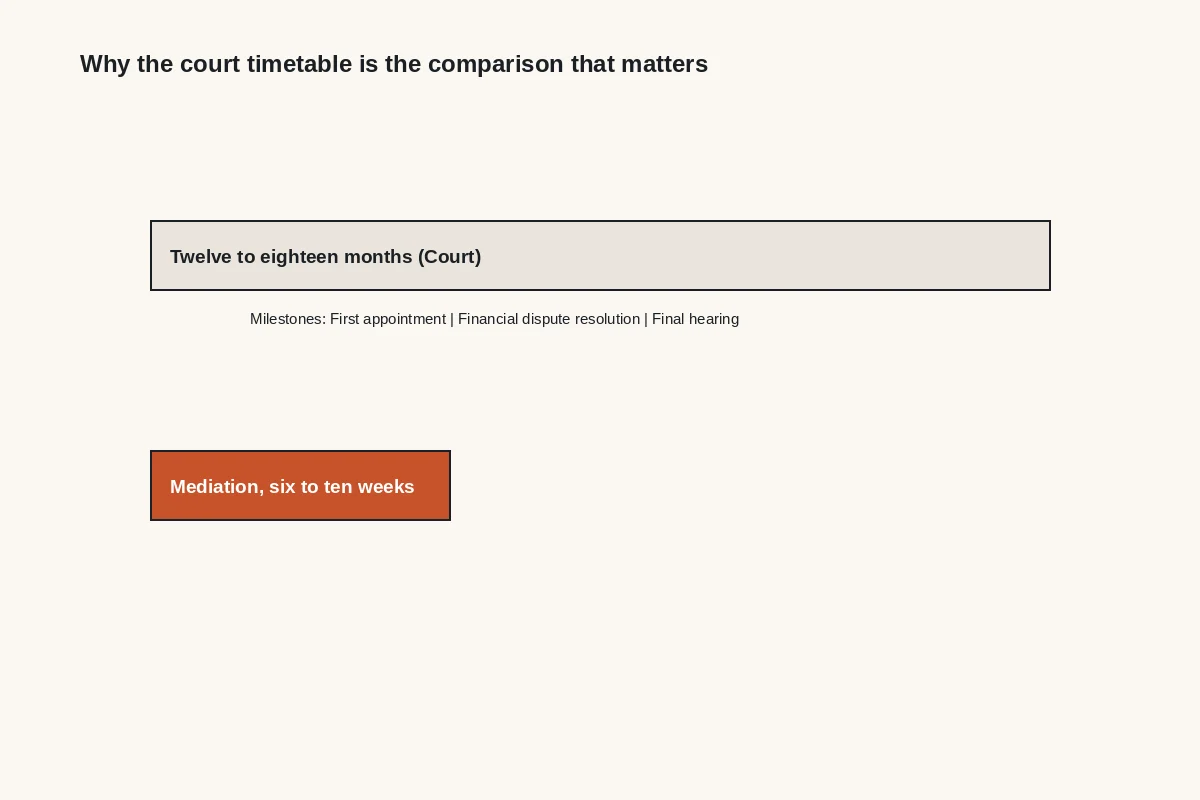
A contested financial remedy case follows a three hearing structure. The First Directions Appointment establishes what information is missing. The Financial Dispute Resolution appointment is where a judge gives an indication of the likely outcome, and a large share of cases settle there. Only if it does not is a final hearing listed. Each stage is set by court availability, and the whole sequence commonly runs twelve to eighteen months.
Child arrangements applications follow a different path. A first hearing dispute resolution appointment is generally listed six to twelve weeks after issue. If the matter does not resolve there, the court frequently orders a section 7 report from Cafcass, which takes twelve to sixteen weeks on its own before any further hearing can be listed.
Those figures are the reason mediation timescales look the way they do. Six to ten weeks against six to eighteen months is not a marginal improvement, and it is the single strongest practical argument for trying mediation first.
What happens between sessions
The gap is working time rather than waiting time. After a first financial session you will typically be gathering bank statements, requesting pension valuations, obtaining property appraisals and speaking to a mortgage broker. After a first child arrangements session you are usually trying an arrangement to see whether it works in practice.
Couples who treat the gap as homework finish faster than couples who treat it as a pause. The mediator will tell you exactly what is needed before the next session, and arriving without it costs a session rather than a week.
The steps after agreement, which people forget to budget for
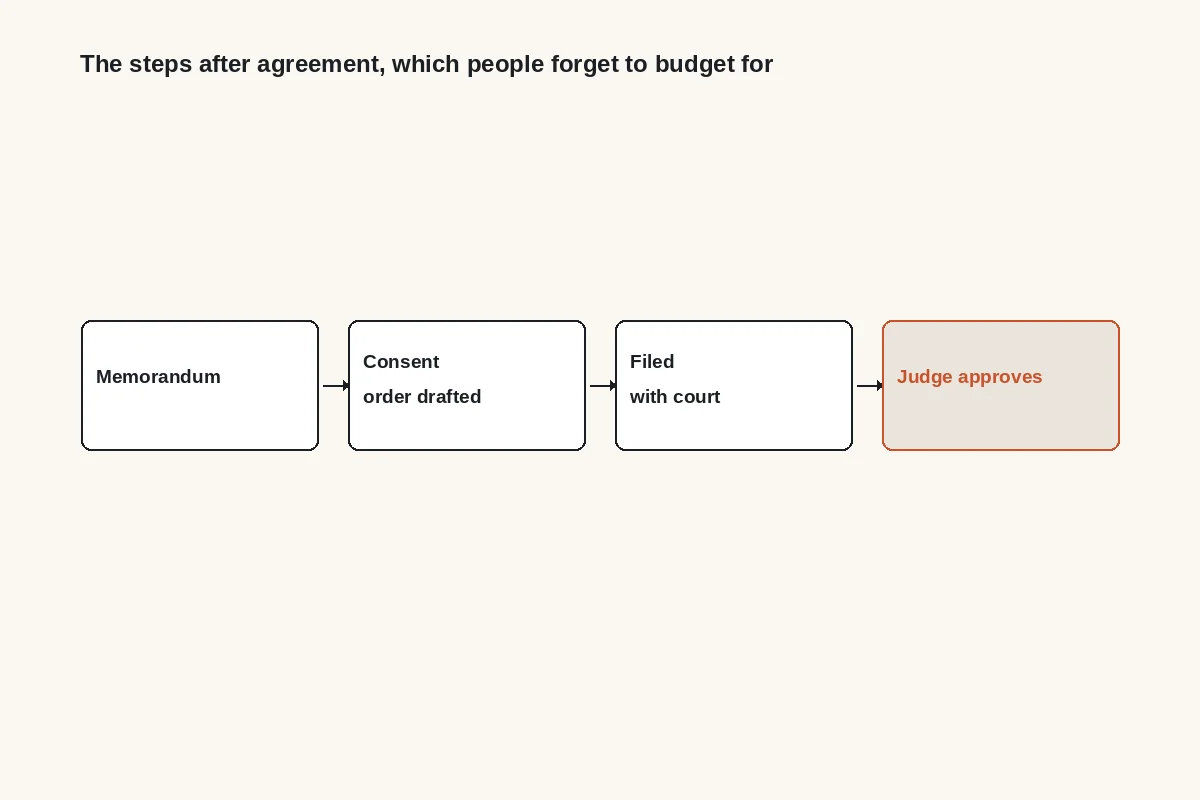
Reaching agreement in the room is not the end of the timeline. The mediator drafts the memorandum of understanding and, for financial cases, the open financial statement. That usually takes one to two weeks.
You then take those documents to a solicitor, who drafts the consent order. Allow two to four weeks, longer if either party wants changes. The order is then filed with the court, and a judge considers it without a hearing. Court approval currently takes between six and twelve weeks depending on the court's workload, and it is entirely outside anyone's control.
So a financial case that reaches agreement in ten weeks of mediation may not have a sealed order for another three to four months. Knowing that in advance prevents the disappointment of thinking it is finished when the last piece is still moving.
Circumstances that genuinely take longer
A defined benefit pension needing an actuarial report. Allow four to eight weeks for the report on top of the valuation that precedes it.
A business that has to be valued. A forensic accountant's report on a trading company is a substantial piece of work and rarely arrives in under six weeks.
A property where the parties cannot agree a value. Two market appraisals usually settle it. Where they do not, a formal RICS valuation adds two to three weeks.
An international element, such as an asset or a pension held abroad, or one party living overseas. These are not obstacles to mediation and they do lengthen every step that involves a third party.
Circumstances that finish quickly
Child arrangements where both parents broadly agree and need help writing it down. Two sessions is common and one is possible.
A financial case with no property, no pension of significance and no children. Two to three sessions.
A variation of an existing arrangement that has stopped working. Often a single session, because the ground has already been covered once and only one element has changed.
Booking around real life
Sessions are ninety minutes and most people take them during working hours, which means arranging time away from work. Video sessions have made this considerably easier, and it is worth asking about early or late slots rather than assuming they do not exist.
Where childcare is the constraint, say so. Sessions can be scheduled around school hours, and it is a more common request than people expect.
Two timelines running at once
It helps to think of the process as two clocks. One is the mediation clock, which the two of you control almost entirely: how quickly you gather documents, how soon you can both make a session, whether you come to each meeting having done what was asked. The other is the third party clock, which you do not control at all: pension scheme response times, valuers, mortgage lenders and, at the end, the court's approval queue.
Almost every case that runs long does so because the second clock was started late. A couple who requests pension valuations in week one and gathers everything else while waiting will finish months sooner than a couple who discusses options for six weeks and then discovers the valuation takes three.
The practical instruction that follows is simple and it is the most useful thing on this page: start every request that depends on somebody else on the day you decide to mediate, before the first joint session, and treat the sessions as the place where the information gets used rather than the place where it gets requested.
What a realistic schedule looks like written down
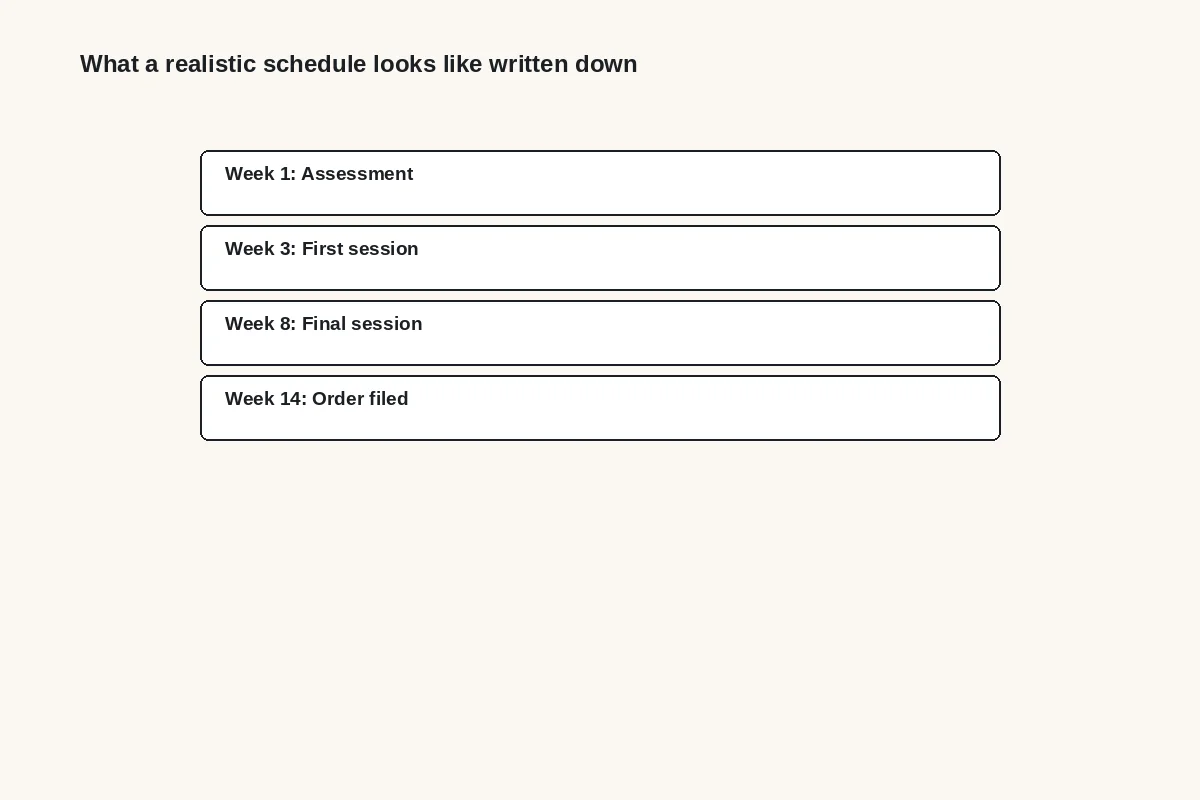
Week one, both MIAMs and every third party request sent. Weeks two to four, first joint session and documents arriving. Weeks four to seven, second and third sessions, options narrowed. Weeks eight to ten, final session and the memorandum drafted. Weeks ten to fourteen, solicitors review and the consent order is drafted and signed. Weeks fourteen onward, the court considers it.
That is a case that goes well, and it is achievable. Write the dates into a calendar at the start and the process stops feeling open ended, which is a large part of what makes it wearing.
How Mediation Direct can help in Grimsby
A structured, confidential process helping separating couples reach lasting agreements on living arrangements and family finances.
Frequently Asked Questions About Our Services in Grimsby
What is the primary cause of scheduling pauses in mediation?
Waiting for third-party paperwork, specifically Cash Equivalent Transfer Values (CETVs) from pension scheme administrators and formal mortgage capacity letters, represents the most common cause of scheduling pauses.
Can urgent child arrangements be agreed in one session?
Yes. Urgent interim arrangements regarding holiday handovers or school schedules can often be resolved in a single focused 90-minute mediation session.
How long do joint mediation sessions last?
Standard joint mediation sessions last 90 minutes, allowing sufficient time for thorough discussion without causing decision fatigue.
Can we speed up our mediation timeline?
Yes. Gathering the financial paperwork before the first session, and booking sessions close together, removes the two things that most often stall a case.
How does the mediation timeframe compare to family court?
Contested court applications average 40 to 60 weeks in England and Wales, whereas mediation typically concludes in 4 to 8 weeks.
What happens once the final documents are completed?
Your solicitor prepares a draft Consent Order based on the Memorandum of Understanding and submits it to court for administrative sign-off within 2 to 4 weeks.
Does the timeline change if one of us lives abroad?
Video sessions remove the travel problem entirely, so the sessions themselves are unaffected. What lengthens is anything requiring an overseas third party, such as a foreign pension valuation or a property appraisal, and those steps should be started in the first week rather than when the discussion reaches them.
What is the shortest a case can realistically take?
A variation of an existing arrangement that has stopped working can be resolved in a single session, because the ground has been covered once and only one element has changed. A straightforward financial case with no property and no significant pension usually takes two to three.
Do we have to wait for the divorce before starting?
No. Mediation can begin at any point and most people start before or alongside the divorce application. The only step that must follow the divorce timetable is the sealing of the financial consent order, which cannot be approved before the conditional order stage.
What happens if we stop partway through?
Nothing is lost. Any agreement reached is recorded, and a case that resumes later starts from that record rather than from the beginning. Where matters do move to court, a narrowed dispute is faster and cheaper than a whole one.
About the author

Authored and reviewed by Family Mediation Council (FMC) accredited family mediators. Every procedural timeline and statutory requirement is verified against the Family Procedure Rules 2010 Part 3 and current Ministry of Justice standards.
- FMC Accredited
- Standards Board Registered
- Authorised MIAM Provider
- MoJ Voucher Scheme
Talk to someone who knows Grimsby
No obligation, and nothing is decided on the call. We will talk through where you are and what your options actually are.