

Cost, time and control compared, including the cases where court is right.
Cost
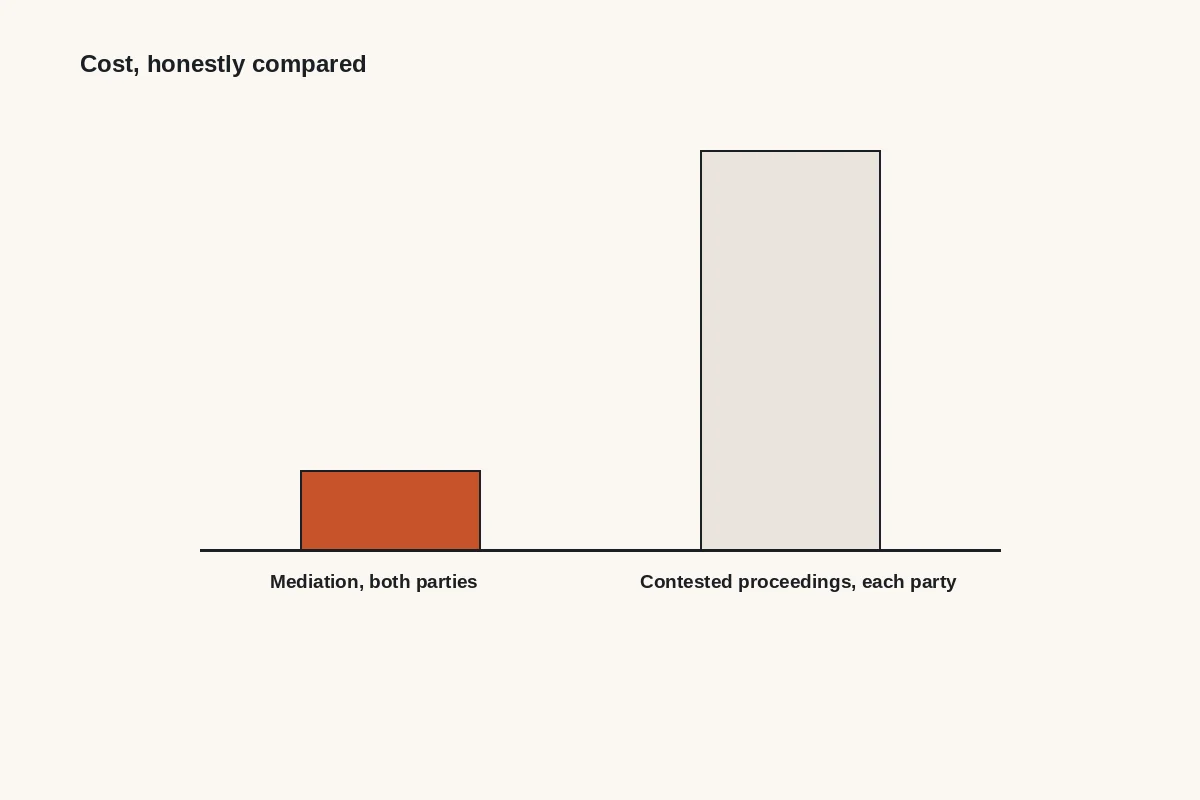
Mediation is charged per session per person, in the low hundreds. A five session financial mediation including the write-up generally lands between 1,500 and 2,500 pounds across both parties, plus a consent order.
A contested financial remedy case commonly reaches 15,000 to 40,000 pounds per party once counsel is instructed and the three hearing structure has run. Contested child arrangements proceedings frequently reach 10,000 to 20,000 pounds per party. These are not different prices for the same thing; they are different orders of magnitude.
Time
Mediation runs in weeks and you choose the dates. A contested financial case commonly runs twelve to eighteen months. A contested child arrangements application generally involves a first hearing six to twelve weeks after issue, and a section 7 report from Cafcass alone takes twelve to sixteen weeks.
Court dates are set by the court's availability and are frequently moved. If either of you needs an answer to plan around, that difference matters more than the money.
Control
In mediation you decide. In court a judge decides, on the material put in front of them, having met your family for a few hours. Judges do this carefully and they still know less about your children than you do.
There is also a difference in what can be agreed. A court order is limited to what the court has power to make. Two people in mediation can agree arrangements a court would never construct, because they know which details actually matter in their family.
Where court is the right route
Where there has been domestic abuse. Mediation is not appropriate and an exemption applies.
Where one party will not produce honest financial disclosure. Mediation cannot compel it and a court can, including drawing adverse inferences from a refusal.
Where an agreement was reached and then ignored. What you need is enforcement, not negotiation.
Where a decision must be made urgently to prevent irreversible harm.
In these situations mediation is not a cheaper alternative. It is the wrong tool, and a service that takes your money without saying so is not doing its job.
They are not mutually exclusive
Mediation narrows the issues even when it does not settle everything. Agreeing the children and leaving the finances to a hearing removes the most emotionally difficult part from the court process. A hearing on two questions is shorter and considerably cheaper than one on ten.
Attempting mediation does not weaken your position. What is discussed is confidential and without prejudice, and attempting it is what the court expects you to have done.
The honest test
Can the two of you sit in a process, with a third person managing it, and negotiate safely and honestly. Not amicably; that is not required and it is rarely present. Safely and honestly. If yes, mediation will almost always serve you better. If no, court exists for exactly that reason and using it is not a failure.
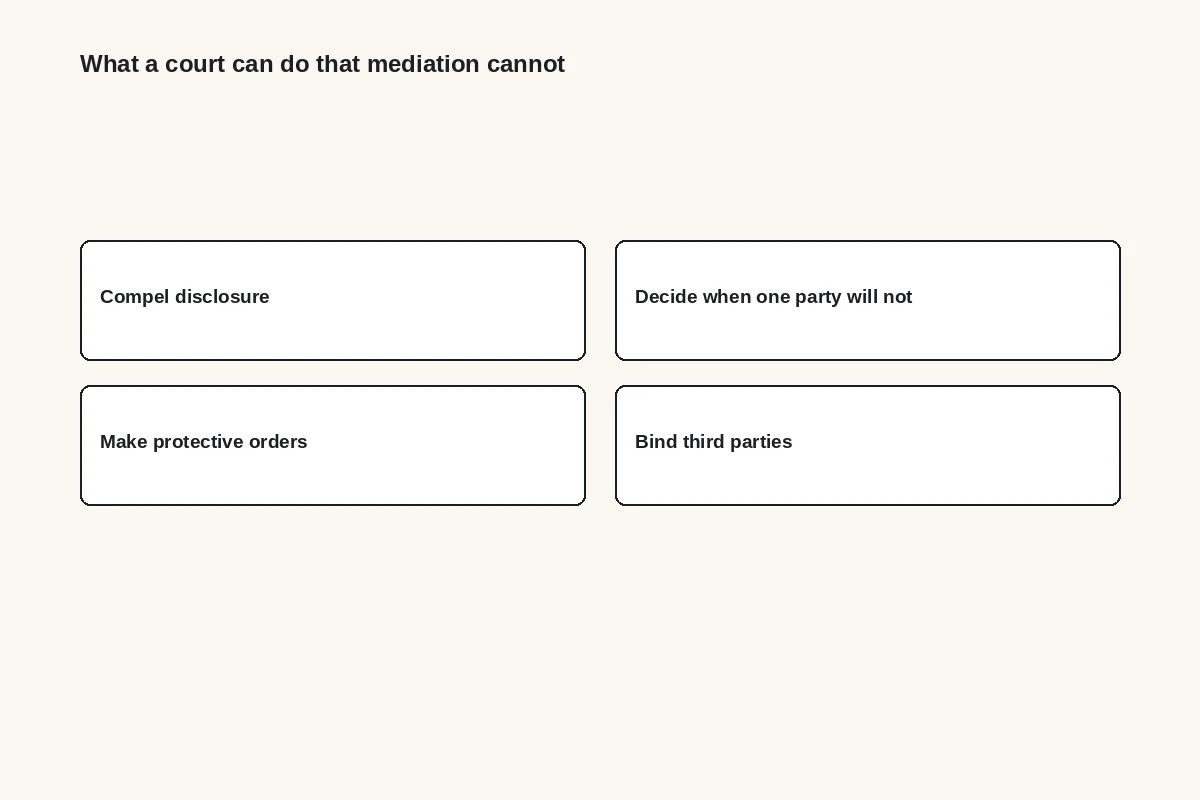
What a court can do that mediation cannot
A court can compel. It can order a party to produce a document, order a third party such as a bank or an employer to produce one, and impose consequences when an order is ignored. Mediation has no such power and does not pretend to.
A court can decide when one person will not agree to anything. Mediation requires two people willing to reach an outcome. Where one is not, no amount of skill in the room produces an agreement, and a mediator who keeps a case going in that situation is charging for a process that cannot work.
A court can make orders that protect. A non-molestation order, an occupation order, a prohibited steps order preventing a child being removed from the country. These are urgent protective remedies and mediation is not an alternative to them.
A court can bind a third party in ways mediation cannot reach, and it can set aside a transaction made to defeat a claim.
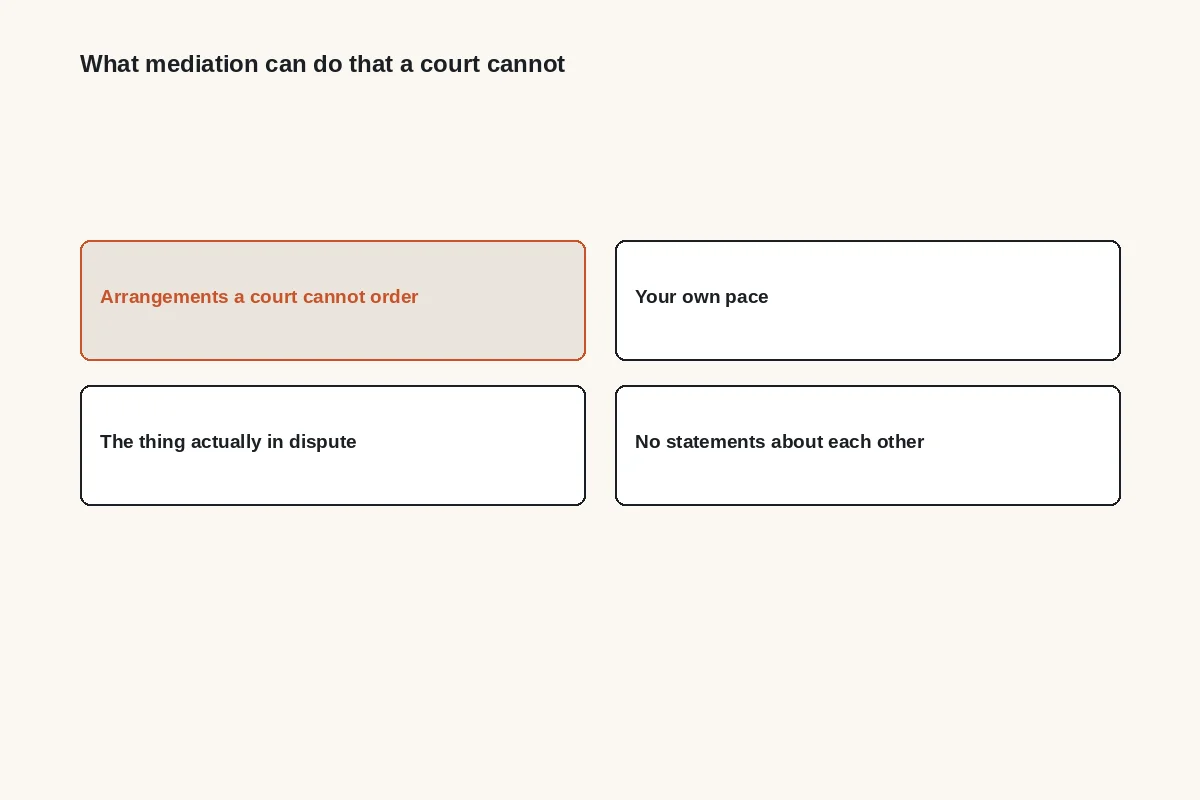
What mediation can do that a court cannot
It can produce an arrangement a court has no power to order. A court cannot order a parent to attend a school play, cannot order how information about a child's health is shared, and cannot order that the two of you use a particular app to communicate. A parenting plan can contain all of it, and those details are frequently what makes daily life workable.
It can move at your pace rather than the court's. A first session in two to three weeks, rather than a first hearing when the list allows.
It can deal with the thing that is actually in dispute. Court proceedings narrow a family's situation to the issues the law recognises. A good deal of what makes a separation difficult is not a legal issue at all, and mediation has room for it.
And it does not require you to set out in a statement why the other person is a poor parent. Litigation asks each side to make the worst honest case about the other. Two parents who have done that to each other in writing have to co-parent afterwards.
The question that actually decides it
Not whether you get on. Most separating couples do not get on, and mediation is full of people who are angry with each other.
The question is whether you can both engage honestly with a process where nobody has the power to make the other comply. That requires two things: that neither of you is afraid of the other, and that both of you are prepared to disclose fully. Where those hold, mediation usually works, even between people who cannot be in the same room, because shuttle mediation exists for exactly that.
Where either fails, mediation is the wrong tool and using it wastes time you do not have.
Cost, honestly compared
A mediated financial settlement, including the consent order that makes it binding, commonly comes to a few thousand pounds shared between two people. A contested financial remedy case commonly runs into five figures per party.
The gap is not a marketing claim, it is a structural fact: proceedings involve two sets of solicitors preparing for three hearings under a court timetable, and mediation involves one professional in a room with both of you.
The cost that is easiest to overlook is not money. Contested proceedings take a year or more of a person's attention, and people routinely describe that as the more expensive part.
Using both
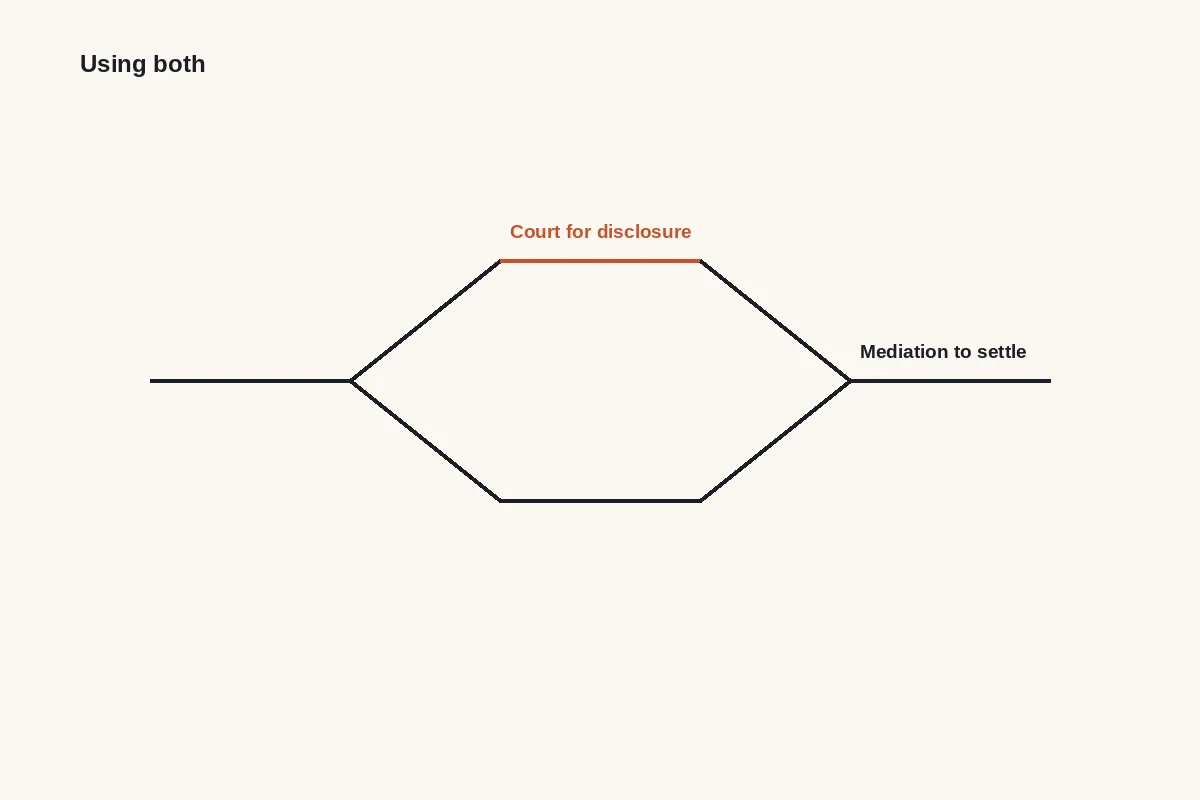
This is more common than the framing suggests, and it is often the right answer. Applying to court does not end the possibility of mediation, and a case can settle at any point up to the final hearing.
Some couples issue proceedings to obtain disclosure that has not been forthcoming, then mediate once the picture is complete. Some mediate everything and use the court only to approve the consent order, which is the ordinary route. Some resolve the children in mediation and litigate the finances, or the reverse.
Partial agreement is not failure. A case that arrives at court with the schedule agreed and one issue outstanding is faster, cheaper and less damaging than one that arrives with everything in dispute.
What the court expects of you first
For most family applications you must attend a MIAM before applying, unless an exemption applies. That is not a formality. The rules also allow the court to take a party's conduct in relation to non-court dispute resolution into account when deciding costs, and recent changes have strengthened the court's ability to pause proceedings to allow it.
The practical position is that the court expects to see that you tried, and a party who did not try is not in a strong position when the subject comes up.
Arbitration, which sits between the two
Family arbitration is worth knowing about and is frequently overlooked. You appoint an arbitrator, who decides the case and produces an award that is then converted into a court order. It is binding, unlike mediation. It is private, faster than court, and you choose the arbitrator and the timetable.
It costs more than mediation, because you are paying a decision maker for their time and usually representing yourselves through solicitors. For a couple who genuinely cannot agree on one point but do not want a year of proceedings, it is often the best available answer.
How to decide, in practice
If you are frightened of the other person, or there has been abuse, take advice about protective remedies first. Mediation is not the starting point and there are exemptions for exactly this.
If you believe assets are being concealed and requests have gone unanswered, court powers are the reason to go there.
If there is a genuine emergency, apply.
Otherwise, in most cases, a MIAM is the cheapest information you will buy in this whole process. It commits you to nothing, it takes an hour, and it produces the form you need if the answer turns out to be court after all.
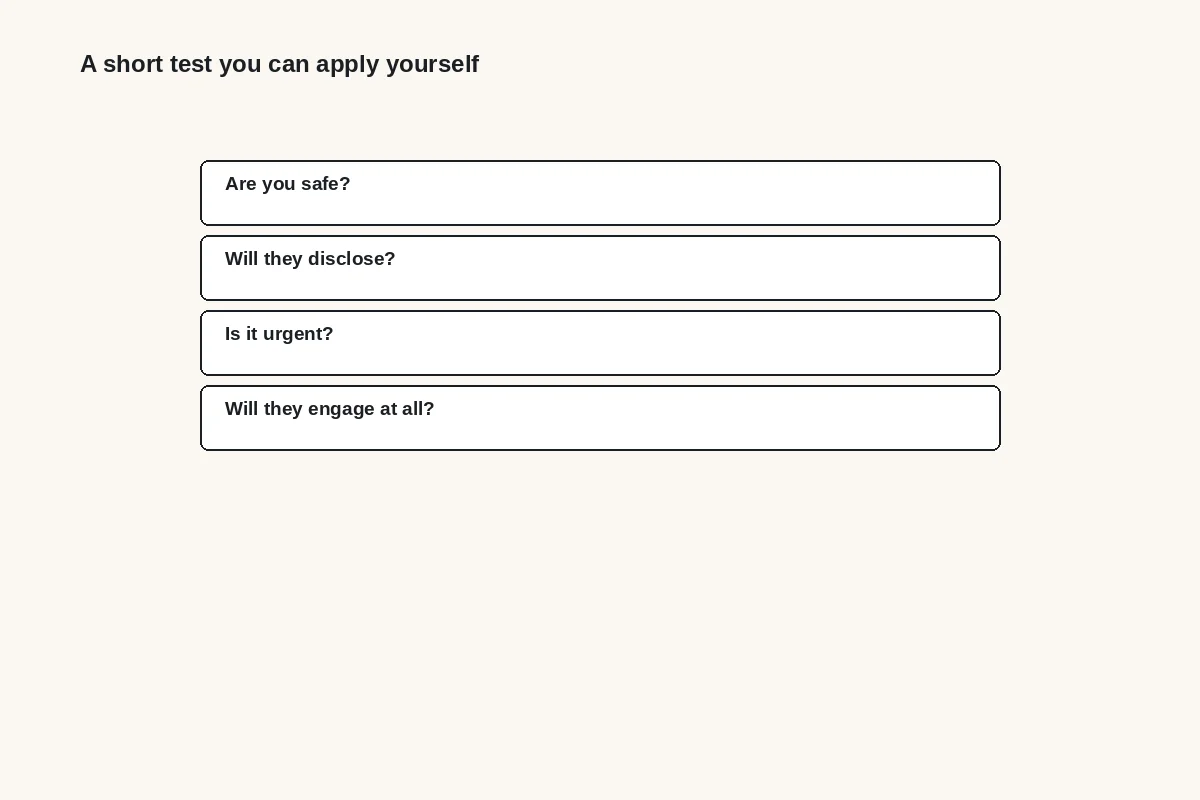
A short test you can apply yourself
Four questions, answered honestly.
Are you safe to be in a process with this person, in some format. If not, mediation is not the starting point and an exemption exists.
Do you believe they will disclose fully. If they will not and requests have already been ignored, the powers you need are the court's.
Is there something that has to be decided in days rather than weeks. If so, apply.
Is either of you refusing to reach any outcome at all, as a position rather than as a negotiating stance. If so, someone will have to decide it for you.
Four noes point clearly at mediation. A yes to any of them does not rule mediation out, and it does mean taking advice before starting, so that the choice is made on the facts rather than on hope.
How Mediation Direct can help in Grimsby
A structured, confidential process helping separating couples reach lasting agreements on living arrangements and family finances.
Frequently Asked Questions About Our Services in Grimsby
Does trying mediation weaken my position in court?
No. Discussions are confidential and without prejudice, and attempting mediation is what the court expects.
What if we agree on most things but not everything?
That is a good outcome. Narrowing a dispute to two issues makes any hearing far shorter and cheaper than a fully contested one.
Can I go to court if mediation fails?
Yes. The mediator signs the form confirming you attended a MIAM and your application proceeds.
Is a mediated agreement legally binding?
Not by itself. A solicitor converts it into a consent order, and that order is what a court enforces.
What if my ex-partner just wants to delay?
Mediation depends on both parties engaging. Where one is using it to delay, that becomes apparent quickly and court is the appropriate route.
Do I need a solicitor if we mediate?
Not for the mediation itself, and taking independent advice alongside it is sensible. You will need one for the consent order.
Is court ever faster?
Only for genuine emergencies, where an urgent application can be heard within days. For everything else mediation is substantially faster.
What if there was abuse but I have no evidence?
Speak to a domestic abuse support service. They can often help evidence an exemption, and mediation should not proceed where you would not be safe.
Can we mediate after proceedings have started?
Yes, and it happens often. Courts encourage it, and settling mid-proceedings avoids the most expensive stages.
Which is better for the children?
Where it is safe, mediation, because it lowers conflict between the people who will co-parent for years. Where it is not safe, court protects them and that is what matters.
About the author

Authored and reviewed by Family Mediation Council (FMC) accredited family mediators. Every procedural timeline and statutory requirement is verified against the Family Procedure Rules 2010 Part 3 and current Ministry of Justice standards.
- FMC Accredited
- Standards Board Registered
- Authorised MIAM Provider
- MoJ Voucher Scheme
Talk to someone who knows Grimsby
No obligation, and nothing is decided on the call. We will talk through where you are and what your options actually are.