

The documents, why guesses do not work, and the one thing mediation cannot compel.
Why disclosure comes before anything else

You cannot divide what you have not measured. People often want to start with proposals, and it wastes weeks: a settlement built on an estimated pension value falls apart when the real figure arrives, and by then both of you have negotiated around a number that was never true.
Disclosure in mediation is open rather than privileged. Unlike the discussions, it can be referred to later and it forms the open financial statement that supports the consent order. That is deliberate. A settlement built on figures either party could later deny is worth nothing.
What you need to provide
Income
Last three months' payslips, or two years of accounts and tax calculations if self employed. Your most recent P60. Details of bonuses, commission, dividends and benefits in kind.
Property
A market appraisal for each property, and ideally more than one. The current mortgage statement showing the outstanding balance and any early repayment charge.
Savings and investments
Twelve months of statements for every account in your name or held jointly, including accounts with small balances. ISAs, shares, premium bonds and cryptocurrency holdings.
Pensions
A cash equivalent transfer value for every pension you hold, including old ones from previous employment. Request these first: they routinely take several weeks and public sector schemes are often slower.
Debts
Statements for credit cards, loans, overdrafts, hire purchase and any money owed to family. Joint debts and sole debts both.
Business interests
Accounts for the last two years, and details of your shareholding and directorships.
The document people forget
Old pensions. A person who has worked for four employers usually has four pension pots and frequently remembers one. The government's Pension Tracing Service will find schemes you have lost track of, and doing that early is worth an hour.
What happens if someone will not disclose

Mediation stops. A mediator has no power to compel disclosure and no power to investigate, and continuing without it would produce an agreement built on a foundation one party knows is false.
A court does have those powers. It can order disclosure, draw adverse inferences from a failure to provide it, and impose penalties. If you genuinely believe your ex-partner is concealing assets, that is a reason to go to court rather than a reason to press on in mediation, and we will say so.
What if I am the one who does not want to disclose

It is worth being honest about the arithmetic. Non-disclosure discovered later can set aside a consent order entirely, years afterwards, with costs consequences. The case law on this is not sympathetic. Whatever is being protected is almost never worth the exposure.
How long it takes to gather
Most people can assemble everything except pension valuations within two weeks. The valuations set the pace of the whole case. Requesting them at your first enquiry rather than when the mediator asks routinely takes a month off the timeline.
Why this is the part that decides everything
Every settlement rests on the picture of what exists. If the picture is wrong, the settlement is wrong, and it stays wrong until somebody discovers it. This is the reason disclosure comes first and the reason a mediator will not move to discussing options while it is incomplete.
It is also the part most people find tedious, and the part where a case most often stalls. A fortnight spent gathering documents properly saves considerably more than a fortnight later.
The documents, item by item
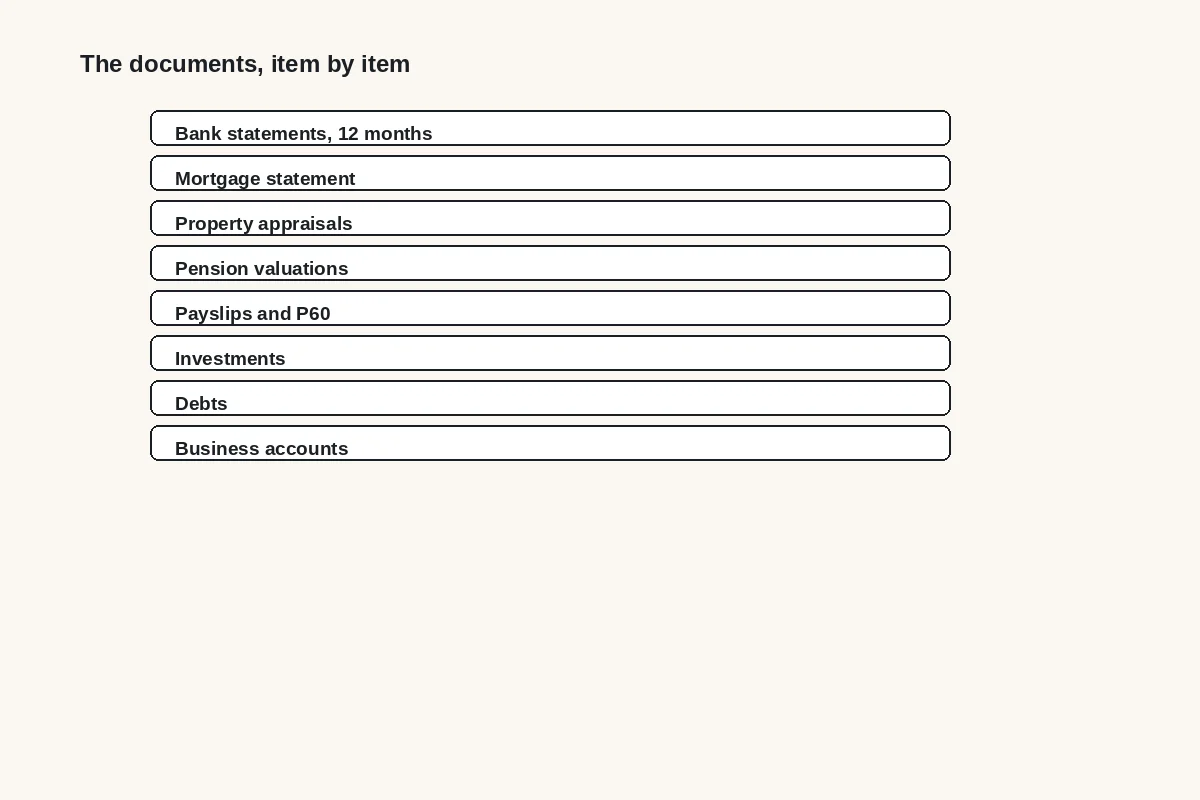
Twelve months of statements for every account in your name or jointly held, including accounts with a nil or negative balance and accounts you have stopped using. Twelve months rather than three, because a shorter window shows a balance rather than a pattern.
A recent mortgage statement for each property, showing the outstanding balance and any early repayment charge. Market appraisals from two or three local agents, or a formal valuation where you disagree.
A cash equivalent transfer value for every pension, requested from the scheme in writing for divorce purposes. Include pensions from former employers, including ones you have forgotten. The Pension Tracing Service will find schemes you cannot locate, and it is free.
Your last three payslips and your most recent P60. If you are self employed, two years of accounts and your most recent tax calculation and tax year overview from HMRC.
Statements for every investment, ISA, share holding and premium bond holding. Surrender values for any life policy with one.
Statements for every debt: credit cards, loans, car finance, overdrafts, anything owed to family.
Business accounts and a director's loan account statement where you have an interest in a company.
The duty, and how long it lasts
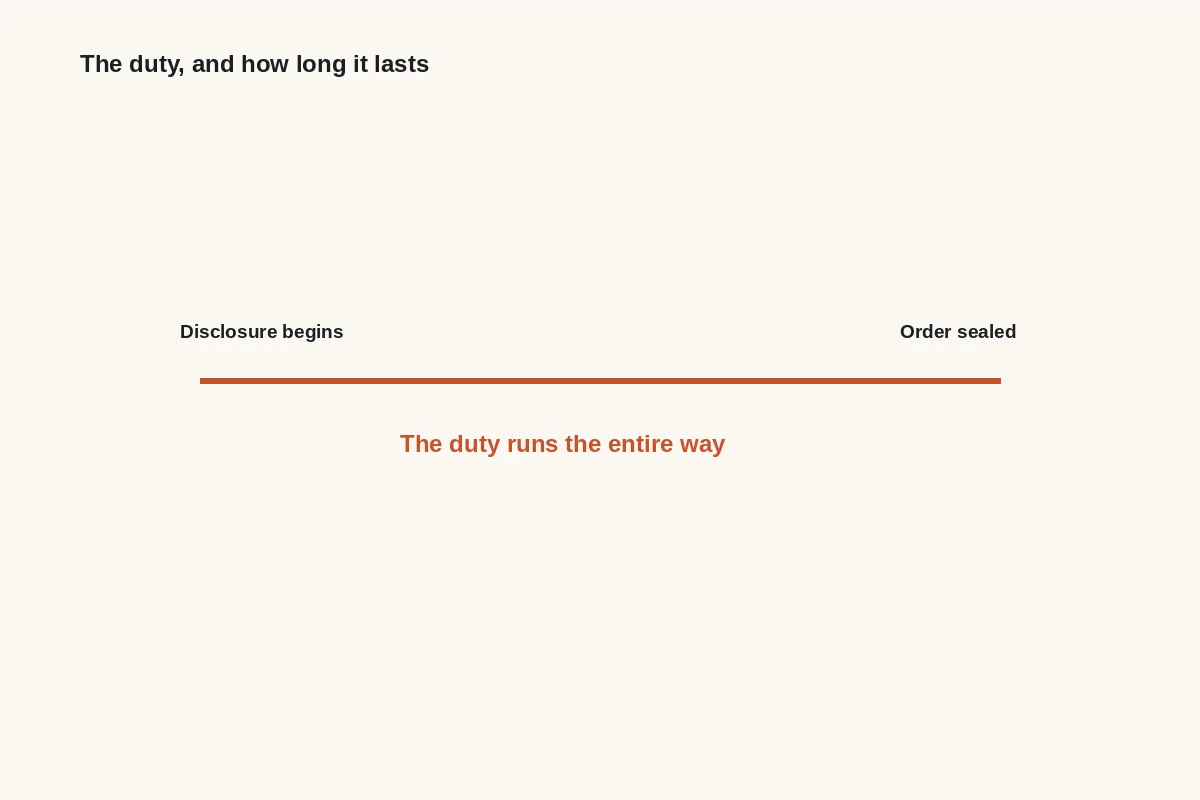
Disclosure is full and frank, and it is continuing. Something that becomes true after you have disclosed has to be disclosed too: a bonus, an inheritance, a redundancy, a new job, a property that goes under offer.
The duty does not stop when the agreement is drafted. It runs until the order is sealed by the court. A person who learns of a windfall the week before the order is approved and says nothing has breached the duty, and that is precisely the fact pattern in the reported cases where orders have been set aside.
What happens when disclosure is not complete
In mediation, the mediator will say so and will not proceed on an incomplete picture. That is not a judgement about honesty, it is the only defensible position: an agreement built on an unknown is not safe for either of you, including for the person who provided everything.
In court, the consequences are firmer. A judge can draw adverse inferences, which means assuming the missing asset is worth more than the party is willing to say. Costs orders follow non-disclosure regularly, and the Supreme Court has confirmed that a settlement reached on a materially incomplete picture can be reopened years later.
Things people forget, and one that is often deliberate
Forgotten routinely: a small pension from a first job, a dormant ISA, a shared savings account for a child, a car worth more than they think, an endowment policy, cryptocurrency, and money lent to a sibling that was always meant to come back.
Hidden deliberately, less often but it happens: an account in a single name held offshore, a bonus deferred by agreement with an employer, an income routed through a company, and assets transferred to a family member shortly before or during the separation. Courts have wide powers to set aside transactions made to defeat a claim, under section 37 of the Matrimonial Causes Act 1973, and a transfer within three years attracts a statutory presumption about its purpose.
Mediation disclosure and Form E
In mediation the same information is gathered, usually on the mediator's own schedule rather than the court form, and it is supported by the same documents. Where a case might end up in proceedings, some mediators use Form E itself so that nothing has to be redone.
The critical distinction is what happens to it afterwards. Discussion in mediation is privileged and cannot be referred to in court. Financial disclosure is not privileged. That is deliberate: it means a person cannot use mediation as a place to reveal an asset that then disappears again if the case moves on.
The document that records disclosure at the end of a mediation is the open financial statement, and it is open precisely so it can be shown to the court with the consent order.
If you suspect something is missing
Say it in the session, plainly, and say what makes you think so. A mediator can ask for a specific document, ask for an explanation of a transfer, and ask for the twelve months either side of a gap.
Vague suspicion is harder to work with than a specific one. "There was a bonus every March and I have not seen this year's" is something a mediator can act on. "I think there is more" is not.
Where the suspicion is serious and unresolved, mediation may not be the right process, and that is a legitimate conclusion to reach. Court proceedings carry powers of investigation that mediation does not.
Doing it efficiently
Request the pension valuations first. They take the longest and everything else can be gathered while you wait.
Download bank statements as PDFs from online banking rather than requesting paper copies. Name each file so it is obvious what it is.
Keep a checklist and mark what has been requested, what has arrived and what is still outstanding. The couples who finish quickly are almost always the ones who treated this as a task with a list rather than a series of individual requests answered one at a time.
Timing your requests
Pension valuations first, on day one, because they set the pace of everything. Property appraisals next, since agents can usually attend within a week. Bank statements and payslips last, because you can produce those in an evening whenever you choose.
Doing it in that order routinely saves a month against doing it in the order the form lists.
What to do with it once it is gathered
Build a single schedule listing every asset, every liability and both incomes, with a document reference against each line. One page, both names, agreed between you.
That schedule becomes the basis of every discussion that follows and it is what turns disclosure from a pile of paper into something you can actually negotiate against. Mediators produce it as a matter of course, and couples who arrive having started one are usually a session ahead.
Once it is agreed, resist reopening it. A schedule renegotiated at every session is a case that does not finish. Where something genuinely new emerges, add it and note the date; where a figure is merely disliked, that is a matter for the settlement rather than for the disclosure.
How Mediation Direct can help in Grimsby
Separating property equity, pension assets, investments, and debt liabilities obligations with transparent, balanced financial solutions.
Frequently Asked Questions About Our Services in Grimsby
Do I have to disclose accounts my ex-partner does not know about?
Yes. Disclosure is full and frank. Undisclosed assets discovered later can set aside a consent order years afterwards, with costs consequences.
How far back do bank statements need to go?
Twelve months is standard. A longer period may be requested where there are unexplained transfers.
What if I do not know where my old pensions are?
The government's Pension Tracing Service will locate schemes from previous employers. It is free and worth doing before your first session.
Is disclosure in mediation confidential?
The discussions are privileged, but the financial disclosure is open. It forms the open financial statement supporting the consent order and can be referred to later.
Do we need formal property valuations?
Market appraisals from local agents are usually sufficient, and more than one is sensible. A formal valuation is used where the parties cannot agree.
What if my ex-partner refuses to provide anything?
Mediation cannot compel disclosure and will stop. A court can order it and can draw adverse inferences from a refusal.
Does an inheritance have to be disclosed?
Yes, including one expected. Whether it forms part of the settlement is a separate question from whether it is disclosed.
What about a new partner's income?
It is not divided, but it can be relevant to needs, so it is generally disclosed in outline rather than in full.
How long does a pension valuation take?
Commonly several weeks, and longer for some public sector schemes. Request them at the very start of the process.
Can I use estimates to get started?
For an early conversation about options, yes. No agreement should be finalised on estimates, because the real figures reliably differ.
About the author

Authored and reviewed by Family Mediation Council (FMC) accredited family mediators. Every procedural timeline and statutory requirement is verified against the Family Procedure Rules 2010 Part 3 and current Ministry of Justice standards.
- FMC Accredited
- Standards Board Registered
- Authorised MIAM Provider
- MoJ Voucher Scheme
Talk to someone who knows Grimsby
No obligation, and nothing is decided on the call. We will talk through where you are and what your options actually are.